Fireplace Screen Buying Guide: Types, Sizes and Do You Need One
A screen is essential for wood fires, smart for gas and optional for electric. Here's how to pick the right type, measure your opening, choose iron, brass or glass, and keep kids and pets safe.
 The Fireplace Co. team
Updated November 12, 2026
7 min read

In this guide 9 sections
Fireplace screens look like a simple purchase until you’re comparing a single panel, a three-panel folding screen and one with doors, in four finishes, at sizes that don’t match your opening. This guide covers which type does what, how to measure, which materials hold up, and how the answer changes for wood, gas and electric fireplaces.
Do you need a fireplace screen?
It depends on what’s burning.
- Wood-burning fireplace: yes. Logs pop and throw embers onto rugs and floors, and a screen is the barrier that stops them. The U.S. Fire Administration’s heating fire safety tips say to keep a glass or metal screen in front of the fireplace to prevent embers or sparks from jumping out.
- Gas fireplace or gas logs: strongly recommended. Gas doesn’t spark the way wood does, but the glass and surrounding metal get very hot. Under industry standards, affected glass-front gas fireplaces made after January 1, 2015 with glass hotter than 172°F must come with a protective barrier (HPBA). Older units and open gas log sets often have nothing, so a freestanding screen adds a buffer between little hands and hot surfaces.
- Electric fireplace: optional. No embers, no open flame. A screen in front of an electric insert or mantel unit is mostly decorative, though it can help keep a toddler or a curious dog off the glass and away from the heater vent. Just don’t block the heater outlet.
Types of fireplace screens
| Type | What it is | Best for | Watch out for |
|---|---|---|---|
| Single panel (flat or curved) | One framed mesh panel on feet | Clean, modern look; standard openings | Needs feet or a curve to stand stable |
| Three-panel folding | A center panel with two hinged wings | Wider openings, uneven hearths, traditional rooms | Covers less frontage once wings are angled back |
| Screen with doors | A panel or folding screen with opening doors | Wood fires you tend often | Doors must latch closed to stop embers |
| Flat guard | A simple flat panel that sits close to the opening | Small or shallow fireplaces | Can tip if bumped; check the base |
| Decorative | Ornamental metalwork, open designs, glass panels | Electric units, unused fireplaces, summer covers | Open patterns won’t stop sparks |
Single panel screens suit minimal and modern rooms. A curved single panel stands on its own arc and wraps the opening a little. Our Regina 1-panel curved iron screen is an example: 38 inches wide by 32 inches tall with a gold finish.
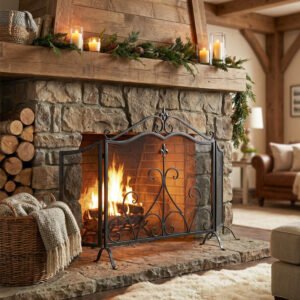
Three-panel folding screens are the most forgiving fit because you can angle the wings to suit the opening and the hearth. The Onyx 3-panel iron screen spreads to 54 inches wide when unfolded, stands 31.5 inches tall, and has an arched top with scrollwork in a black finish.
Screens with doors let you add a log or poke the fire without moving the whole screen. Close the doors every time; an open door defeats the point.
How to measure for a fireplace screen
Measure the fireplace opening, not the surround or mantel.
- Width: measure across the opening at its widest point, brick edge to brick edge.
- Height: measure from the hearth floor to the top of the opening. For an arched opening, measure at the highest point.
- Hearth depth: measure from the opening to the front edge of the hearth. A folding screen’s angled wings need room to stand.
Then add overlap. A screen should sit a few inches wider and taller than the opening so there’s no gap at the sides or top for embers to escape. A good rule of thumb is about 4 to 8 inches wider and 2 to 4 inches taller.
| Opening width | Look for a screen about |
|---|---|
| 28 to 30 in | 34 to 38 in wide |
| 32 to 36 in | 38 to 44 in wide |
| 38 to 42 in | 44 to 50 in wide (or a folding screen with wings angled) |
| 44 in and up | A wide three-panel screen; check its width with wings angled, not just fully flat |
For folding screens, remember that the listed width is usually the fully flat measurement. With the wings angled back so the screen stands, it covers less of the opening’s width. Lay a tape measure on the hearth in the shape you plan to set it up, and check that the center panel plus the angled wings still clear the opening on both sides.
Too big is safer than too small, as long as it fits on the hearth and doesn’t crowd tools or a log holder.
Materials: iron, steel, brass and glass
- Wrought iron and cast iron. Heavy, stable and heat-tolerant. Iron screens stay put when a dog brushes past, and they suit traditional, farmhouse and rustic rooms. Both our screens are iron.
- Steel. Lighter and usually less expensive. Fine for most uses, but check the frame gauge and feet on lightweight steel, which can tip.
- Brass and brass-finish. Classic in formal rooms. Solid brass darkens and needs polishing; brass-tone finishes over iron or steel are easier to live with.
- Tempered glass. A glass screen shows the flame clearly and blocks sparks entirely. It also blocks more radiant heat from a wood fire. It must be tempered glass rated for fireplace use.
- Mesh. This is what actually stops sparks. Look for tight, even mesh across the whole panel, with no gaps where it meets the frame.
Finishes: black, gold and brass
Matte black disappears against dark brick and soot, which makes it the safest choice if you burn wood. It works in nearly every style. Gold and brass finishes read as decor and suit modern glam, mid-century and traditional rooms, especially with a painted or white surround. On a wood-burning fireplace, expect a bright finish to show soot and need occasional wiping. If you’re also adding a mantel, matching metal tones between the screen and the shelf brackets ties the wall together; see our mantel shelves.
Screens for wood, gas and electric fireplaces
Wood: fine mesh is non-negotiable, and the screen should cover the full opening with overlap. Keep it in place whenever there’s a fire or hot embers, and keep rugs and furniture back.
Gas: if your fireplace came with a factory barrier over the glass, keep it installed; a decorative screen doesn’t replace it. With open gas logs (no glass), a mesh screen keeps people, pets and stray paper back from the burner and hot logs. Never block air inlets or controls.
Electric: pick for looks, and stand the screen a few inches in front of the unit so it doesn’t block the heater vent, which is usually at the top or bottom of the front. Decorative open designs are fine here. Not sure which fuel suits your home? Our gas vs electric fireplace comparison covers heat, cost and safety side by side.
Child and pet safety
A decorative screen isn’t a safety gate. It slows a crawling baby or a curious puppy, but a determined toddler can pull a light screen over. If kids or pets are in the house:
- Choose a heavy iron screen with a wide, stable base.
- Avoid open scrollwork with gaps big enough for small fingers or paws to reach through to hot glass.
- Check that hinges don’t pinch and doors latch.
- Keep a 3-foot kid-free zone around a burning fire. For a wood or hot gas unit with a crawler, a hearth gate that anchors to the wall is the safer tool.
Shop fireplace screens
Browse our fireplace screens with sizes listed so you can compare against your measurements. If you’re between sizes or aren’t sure a screen suits your fireplace, ask us with your opening width, height and hearth depth, and we’ll help you pick.
FAQ
Do you need a fireplace screen for gas logs?
It’s recommended. Gas logs don’t throw sparks the way wood does, but the logs, grate and any glass around them get very hot, and a screen keeps kids, pets and stray items back. If your gas fireplace came with a glass barrier screen, keep that installed.
Do I need a fireplace screen for an electric fireplace?
No. There’s no flame or embers, so a screen is decorative. If you add one, leave a few inches of space so it doesn’t block the heater vent.
Are glass or mesh fireplace screens better?
Mesh lets more heat into the room and gives a classic look. Glass stops all sparks, shows the flame clearly and is easier to clean, but it blocks more of a wood fire’s radiant heat. For a wood fire you sit beside often, mesh is the usual pick.
Are fireplace screens still in style?
Yes. Slim single panels in black or gold suit modern rooms, while arched three-panel iron screens remain a staple in traditional and farmhouse homes. Many people use a decorative screen in front of an unused or electric fireplace purely as a styling piece.
How do you clean a fireplace screen?
Let it cool completely, then vacuum the mesh with a brush attachment. Wipe the frame with a damp cloth and mild soap, rinse and dry well to prevent rust on iron. Skip harsh abrasives on painted or gold finishes.
Shop the guide
All fireplace accessories

We write our guides from manufacturer specs and published safety standards, and update them when specs change. Spotted something out of date, or need help with your room? Ask us.